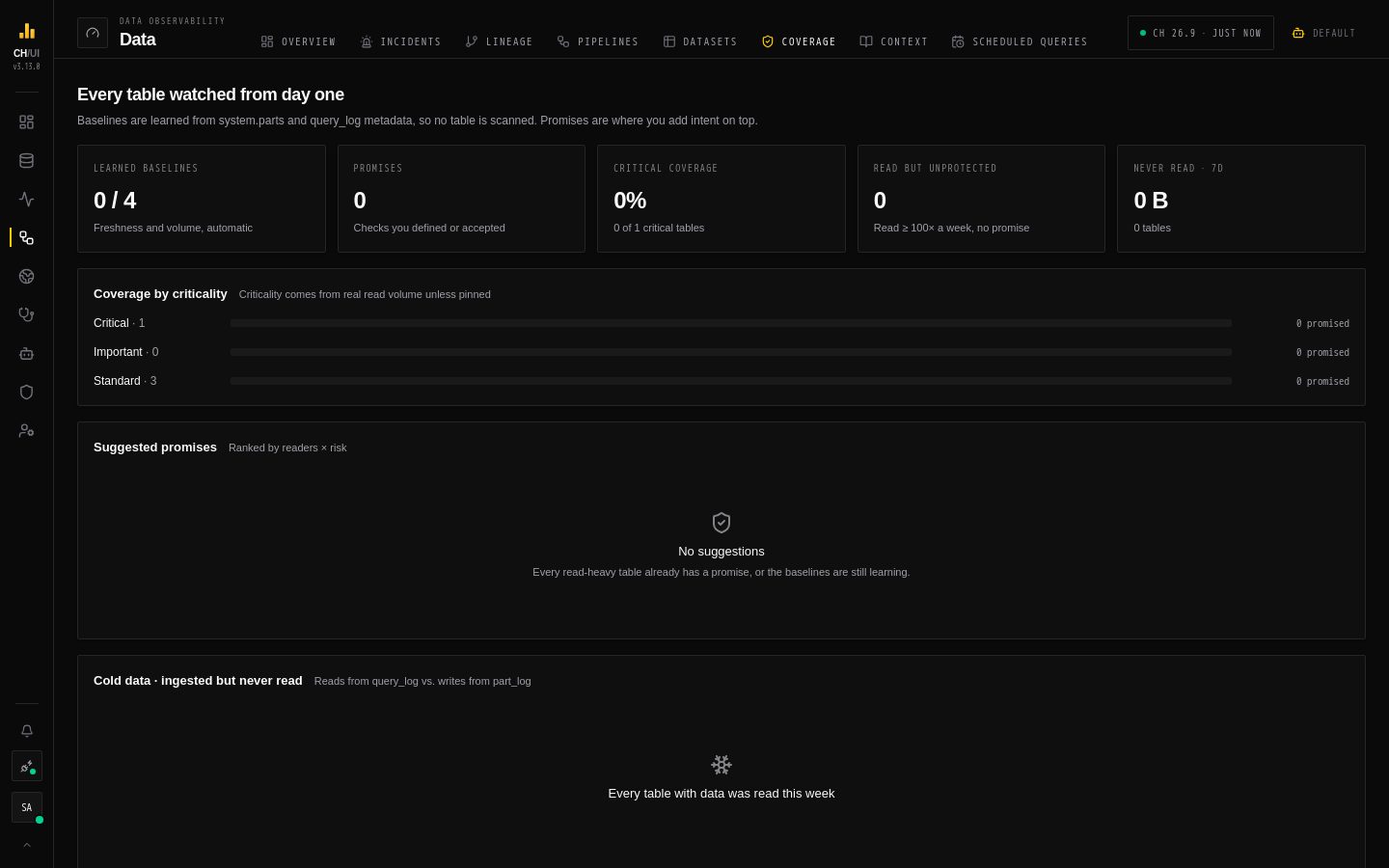
Data › Coverage shows how well your tables are protected and what to protect next. Every table with data is watched from day one by its learned baseline — no table is scanned for it — so coverage is about where you should add explicit intent with a promise.
What's on the screen
Panel
Shows
Learned baselines
Tables watched by their learned freshness and volume baseline
Promises
Tables with at least one promise
Critical coverage
Share of critical tables that have a promise
Read but unprotected
Tables people read that have no promise
Never read · 7d
Tables nobody read in the last week
Coverage by criticality
Promised vs. baseline-only, split by critical, important and normal
Suggested promises
Read-heavy tables without a promise, with who writes them
Cold data
Tables that are still ingested but haven't been read for a week
Accept opens the promise wizard pre-filled for that table (needs data_health:edit). Review the checks, then save.
Dismiss hides the suggestion (needs observe:edit).
Work top-down: critical tables first, then important ones that many people read.
Cold data
A table that is still written but never read costs ingestion, merges and disk for nothing. Check with its owner, then stop the writer, add a TTL, or drop it. Capacity shows how much space it holds.